Neck Injuries Treatment in NJ & NY
The tackle came from behind, and when you stood up the field felt tilted. Two days later you cannot hold your head upright without cupping your chin in your hand, and any sudden movement sends a spike of pain from your skull into your shoulder blade. Metro Pain Centers diagnoses the structural damage from neck injuries and treats the specific tissues that were torn, strained, or compressed so you can hold your own head up again.

Understanding Neck Injuries at Metro Pain Centers
A neck injury is any traumatic disruption of the cervical spine's structural components, including the vertebral bodies C1 through C7, the intervertebral discs, the facet joint capsules, the anterior and posterior longitudinal ligaments, the interspinous ligaments, and the paraspinal musculature, caused by forces that exceed the physiological tolerance of these tissues.
Atlantoaxial instability, the excessive motion between the C1 atlas and C2 axis vertebrae caused by ligamentous damage to the transverse ligament or alar ligaments, is a serious upper cervical injury that Metro Pain Centers screens for in every neck injury patient with persistent upper neck pain and a sensation of head heaviness. When dynamic imaging confirms abnormal C1-C2 motion, our physicians coordinate with neurosurgical colleagues for stabilization.
The cervical spine protects the spinal cord while allowing the head to rotate approximately 180 degrees. This design trades structural rigidity for mobility, making the neck the most vulnerable spinal segment during impact.
Metro Pain Centers treats neck injuries ranging from cervical sprains and strains to disc herniations, facet joint capsule tears, ligamentous instability, and compression fractures. Our physicians determine the injury severity using validated grading systems to guide the safest treatment path.
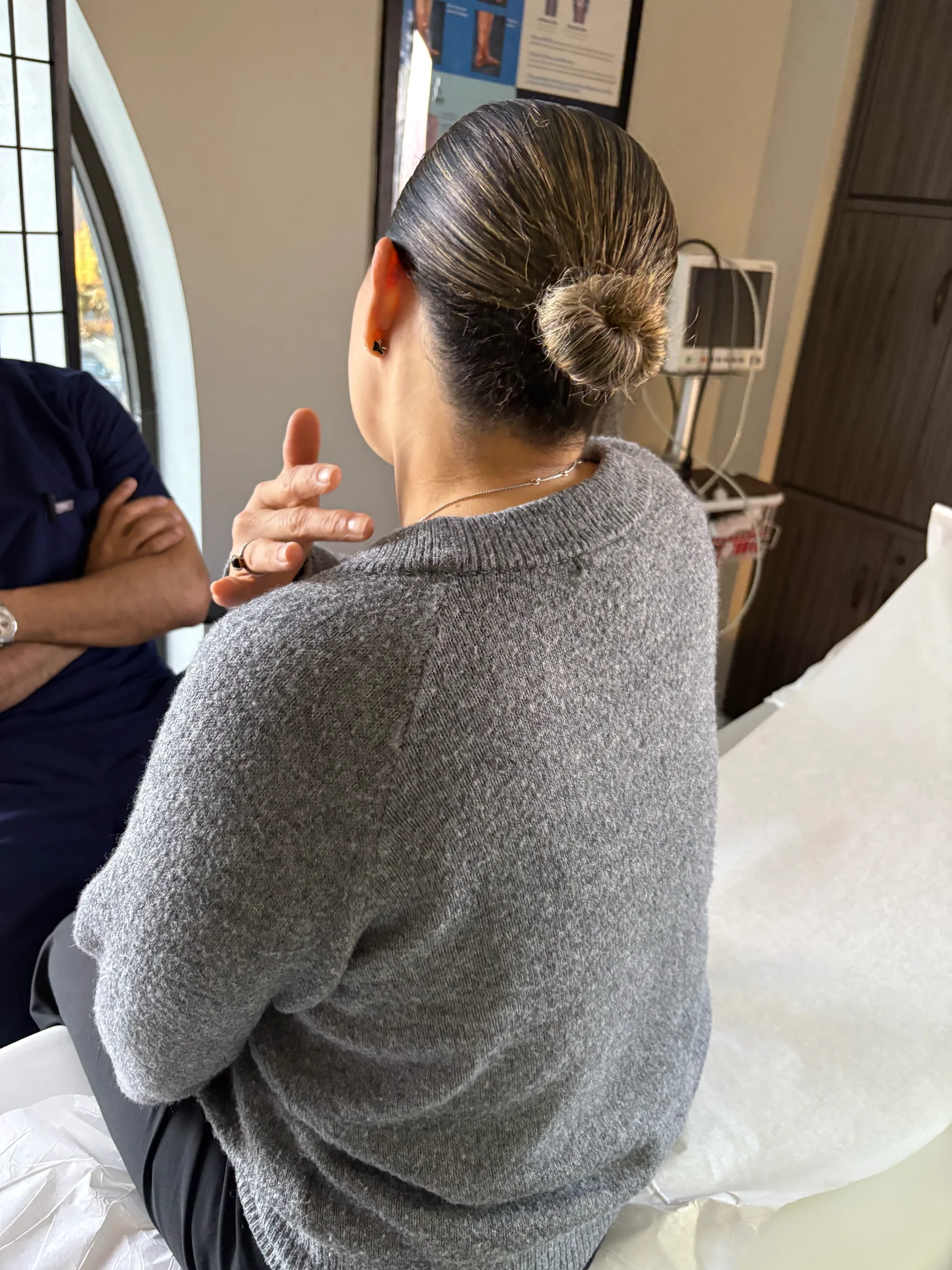
Understanding Your Condition
Our board-certified physicians use advanced diagnostic techniques to accurately identify the source of your pain, ensuring you receive the most effective treatment.
Symptoms of Cervical Neck Injuries
Immediate onset of sharp neck pain following trauma is the primary symptom that distinguishes an acute injury from chronic degeneration. Metro Pain Centers evaluates injury patients within hours or days to prevent delayed complications.
Limited range of motion in all directions with protective muscle guarding suggests significant ligamentous or bony injury. Our pain management physicians assess whether the restriction is muscular splinting or structural instability, because the treatment for each differs fundamentally.
Radiating arm pain, numbness, or weakness developing after a neck injury indicates traumatic disc herniation or nerve root compression. Metro Pain Centers prioritizes cervical MRI when neurological symptoms accompany neck trauma.
Headache originating at the base of the skull, dizziness, and blurred vision after a neck injury may signal upper cervical ligament damage or vertebral artery strain. Our specialists evaluate these symptoms urgently to rule out vascular injury.
What Causes Neck Injuries
Motor vehicle collisions produce the rapid acceleration-deceleration forces that strain cervical ligaments, herniate discs, and fracture vertebrae. Metro Pain Centers treats collision-related neck injuries across the full severity spectrum from whiplash strains to burst fractures.
Contact sports including football, hockey, and wrestling subject the cervical spine to axial loading, lateral bending, and rotational forces that exceed tissue tolerance. Our physicians see these injuries in high school, collegiate, and recreational athletes across NJ and NY.
Falls from height or onto an outstretched head compress the cervical spine axially. Diving into shallow water is a particularly dangerous mechanism that Metro Pain Centers associates with severe upper cervical injuries.
Workplace accidents involving falling objects, machinery, or construction site impacts produce blunt cervical trauma. Metro Pain Centers coordinates with workers' compensation carriers to ensure injured patients receive timely evaluation and treatment.
How Metro Pain Centers Diagnoses Neck Injuries
Physical examination assesses cervical alignment, point tenderness over spinous processes, paraspinal muscle spasm, and neurological function of the C5 through T1 nerve roots. Our board-certified pain specialists apply the Canadian C-Spine Rule to determine imaging urgency.
Cervical CT scans detect fractures, dislocations, and bony malalignment that require immediate stabilization. Metro Pain Centers orders CT when the injury mechanism involves high-energy forces or when X-rays are inconclusive.
Cervical MRI reveals soft tissue injuries invisible on CT, including disc herniations, ligamentous tears, epidural hematomas, and spinal cord edema. Metro Pain Centers uses MRI to evaluate every neck injury patient with neurological symptoms or persistent pain beyond two weeks.
Flexion-extension X-rays detect ligamentous instability by measuring abnormal vertebral translation during controlled neck movement. Metro Pain Centers performs these studies only after fractures have been excluded by CT to ensure patient safety during the dynamic views.
Treatment Options for Neck Injuries at Metro Pain Centers
Cervical epidural steroid injections reduce inflammation around nerve roots compressed by traumatic disc herniations. Metro Pain Centers performs these under fluoroscopic guidance with contrast confirmation to deliver medication precisely to the injured level.
Cervical facet joint injections and medial branch blocks address facet capsule injuries that produce persistent post-traumatic neck pain. When diagnostic blocks confirm the facet joint as the pain source, radiofrequency ablation provides longer-term relief.
Interventional pain management at Metro Pain Centers includes trigger point injections for post-traumatic myofascial pain and occipital nerve blocks for cervicogenic headaches that develop after neck injuries.
Physical therapy progresses from gentle cervical range of motion recovery to strengthening and proprioceptive retraining as the injury heals. PRP therapy supports ligament and disc healing in patients with soft tissue injuries who want to accelerate recovery.
Schedule an appointment to begin your neck injury treatment plan.
Your Neck Injury Specialists at Metro Pain Centers

EXPERIENCE
Led by Dr. Rahul Sood
Led by Dr. Rahul Sood, Chairman of Anesthesiology at New Bridge Medical Centers, Metro Pain Centers provides multilingual care in English, Spanish, Punjabi, and Hindi across all 12 offices.
Our physicians hold board certifications in anesthesiology and pain medicine, with training from Mount Sinai, Rutgers, and Thomas Jefferson University.
Related Conditions Treated by Metro Pain Centers
Neck injuries overlap with several conditions our physicians treat daily. Whiplash is the most common neck injury from rear-end motor vehicle collisions. Cervical herniated discs result from traumatic disc rupture during impact.
Neck pain persists after injuries when facet joints or discs sustain chronic damage. Pinched nerve develops when post-traumatic disc herniations or bone fragments compress cervical nerve roots. Spinal cord injury represents the most severe outcome of cervical trauma.
View all conditions we treat at Metro Pain Centers.
Neck Injury Treatment at 12 NJ and NY Locations
When should I see a specialist after a neck injury?
Any neck injury that produces persistent pain beyond 48 hours, radiating arm symptoms, numbness, weakness, or difficulty holding the head upright warrants specialist evaluation. Metro Pain Centers offers same-day appointments for acute injury patients.
Can neck injuries heal without surgery?
Most neck injuries respond to non-surgical treatment. Metro Pain Centers uses epidural injections, facet blocks, radiofrequency ablation, physical therapy, and regenerative medicine to manage the majority of traumatic cervical conditions without surgery.
How long does recovery from a neck injury take?
Cervical sprains and strains typically improve within 4 to 8 weeks. Disc herniations and ligamentous injuries may require 3 to 6 months. Metro Pain Centers monitors recovery milestones and adjusts the treatment plan at each stage.
Should I go to the emergency room or a pain specialist?
Go to the emergency room first if the injury involved a high-speed collision, a fall from height, or if you experience severe weakness or loss of coordination. After emergency evaluation, Metro Pain Centers manages the ongoing pain and rehabilitation.
Does insurance cover neck injury treatment at Metro Pain Centers?
Metro Pain Centers accepts most major insurance plans including workers' compensation and auto injury coverage. Our billing team verifies your benefits and explains costs before treatment begins.
Hear From Our Patients
The doctors actually listen to you and take time to explain everything. I finally found relief after years of back pain.
From my first visit, I felt like they genuinely cared about helping me get better. The staff is wonderful and the treatments changed my life.
After seeing multiple doctors with no improvement, Metro Pain Centers finally gave me a treatment plan that works. I can't recommend them enough.
Get Relief from Your Neck Injury Today
The pain from your neck injury and the fear that comes with not knowing what is damaged do not have to control your recovery. Metro Pain Centers provides the diagnostic imaging to identify every injured structure and the interventional precision to treat each one.