Meniscus Tear Treatment in NJ & NY
You planted your foot during a basketball game and pivoted, and the pop you felt inside your knee was followed by swelling that made your kneecap disappear by morning. Now the knee locks at random, refusing to straighten until you wiggle your leg and coax it free. Metro Pain Centers identifies the type and location of your meniscal tear and treats it so you can pivot, squat, and straighten your knee without the lock stopping you mid-stride.

Understanding Meniscus Tears at Metro Pain Centers
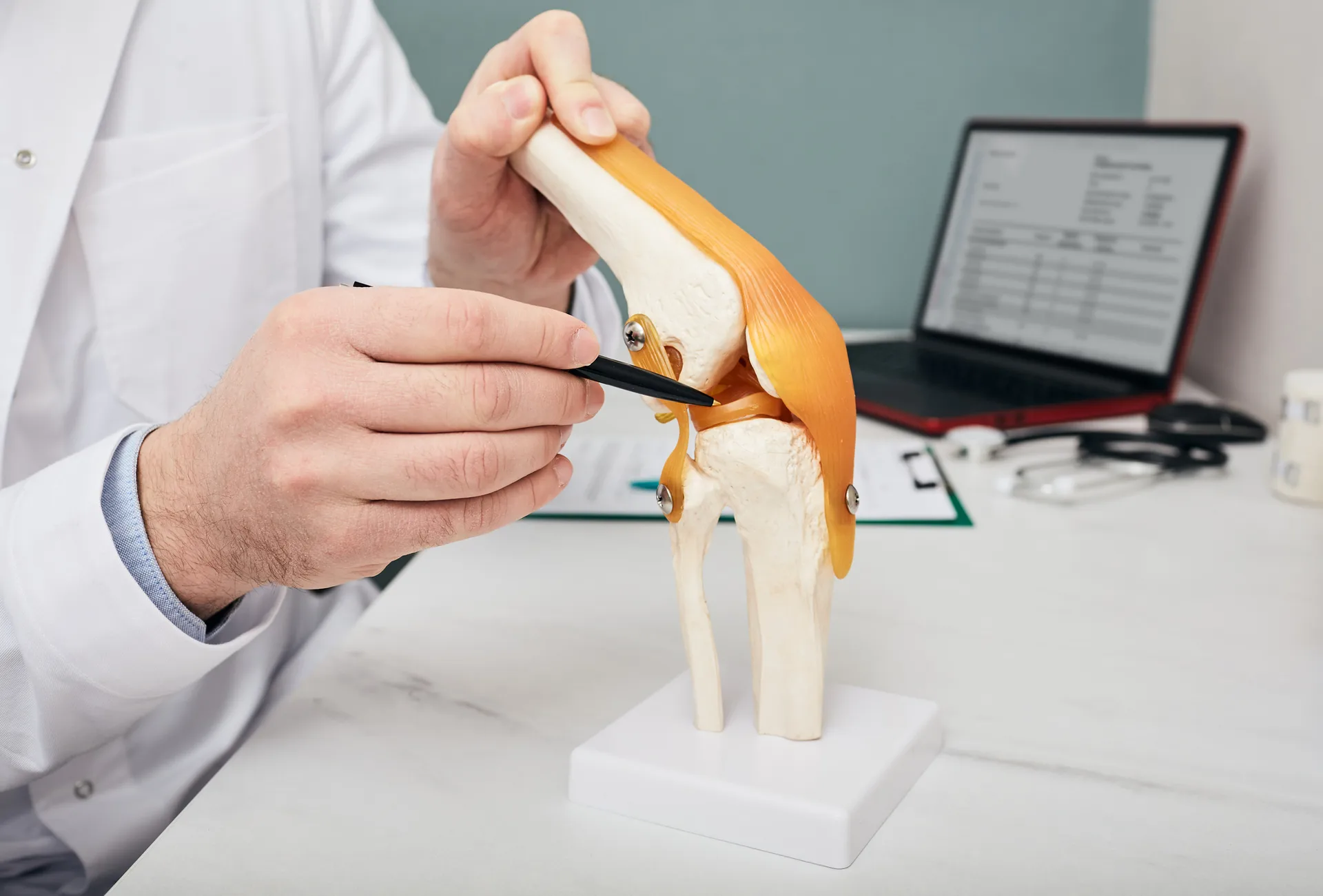
A meniscus tear is a disruption of the fibrocartilage meniscus within the knee joint, where the C-shaped medial meniscus or the O-shaped lateral meniscus that sit between the femoral condyles and the tibial plateau tear through their substance, producing pain, swelling, catching, and locking as the damaged tissue interferes with the smooth gliding motion of the knee.
Mechanical locking, the abrupt inability to fully extend the knee caused by a displaced meniscal fragment wedging between the femoral condyle and tibial plateau during movement, is a hallmark symptom Metro Pain Centers evaluates to determine whether a torn meniscal flap has displaced into the joint space. Identifying a locked knee guides the urgency of treatment.
The menisci distribute approximately 50 percent of the compressive load across the knee during standing and up to 85 percent during deep flexion. Losing this load distribution accelerates cartilage wear in the affected compartment.
Metro Pain Centers treats medial meniscus tears, lateral meniscus tears, bucket-handle tears, radial tears, and degenerative meniscal lesions. Our physicians classify the tear pattern and zone because the blood supply to the tear location determines whether the meniscus can heal.
Understanding Your Condition
Our board-certified physicians use advanced diagnostic techniques to accurately identify the source of your pain, ensuring you receive the most effective treatment.
Symptoms of a Meniscus Tear
A popping sensation during a twisting or pivoting motion followed by rapid knee swelling is the classic acute meniscus tear presentation. Metro Pain Centers evaluates the mechanism and onset speed to distinguish meniscal injury from ligament sprains.
Locking of the knee in a partially bent position that prevents full extension indicates a displaced meniscal fragment. The knee unlocks only when the fragment shifts back out of the way. Our pain management physicians assess locking episodes to determine whether surgical consultation is needed.
Intermittent catching or clicking during walking or stair climbing suggests a torn meniscal flap that shifts with joint motion without fully blocking extension. Metro Pain Centers uses McMurray's test and joint line palpation to reproduce the mechanical catch.
Swelling that returns after activity and subsides with rest indicates ongoing meniscal irritation. Our specialists monitor effusion patterns to track whether the tear is stable or progressing.
What Causes a Meniscus Tear
Acute twisting or pivoting on a planted foot is the most common mechanism of traumatic meniscus tears that Metro Pain Centers diagnoses. Basketball, soccer, and skiing produce the rotational forces that shear the meniscal tissue.
Degenerative weakening of the meniscal fibrocartilage causes tears from minimal or no trauma in patients over age 40. A simple deep squat or awkward step can tear a meniscus that has lost its structural integrity. Metro Pain Centers identifies degenerative tears because they respond differently to treatment than acute injuries.
Combined ACL tear and meniscus tear occurs frequently during high-energy knee injuries. The anterior cruciate ligament rupture allows abnormal tibial translation that overloads and tears the meniscus. Our physicians evaluate ligament stability alongside the meniscus because untreated ligament laxity predisposes the meniscus to re-tear.
Discoid meniscus, an anatomic variant where the lateral meniscus covers the entire tibial plateau rather than forming a C-shape, is more susceptible to tearing because the abnormal shape creates uneven load distribution. Metro Pain Centers identifies this variant on MRI when lateral meniscal tears occur without a clear traumatic mechanism.
How Metro Pain Centers Diagnoses Meniscus Tears
Physical examination includes McMurray's test, Thessaly test, joint line tenderness palpation, and assessment of locking and catching. Our board-certified pain specialists use these provocative maneuvers to localize the tear to the medial or lateral meniscus.
X-rays rule out fracture and assess for joint space narrowing that suggests concurrent arthritis. Metro Pain Centers orders weight-bearing views to evaluate the compartment affected by the suspected meniscal loss.
MRI is the standard imaging modality for confirming meniscus tear location, pattern, and extent. Metro Pain Centers uses MRI findings to classify tears by zone, including the vascular red zone, the transitional red-white zone, and the avascular white zone, because zone location determines healing potential.
Diagnostic knee joint injection with local anesthetic confirms the knee as the primary pain source. When the injection eliminates pain temporarily, Metro Pain Centers uses that information to plan targeted treatment for the verified meniscal pathology.
Treatment Options for Meniscus Tears at Metro Pain Centers
Intra-articular knee injections with corticosteroid reduce the inflammation and effusion that accompany meniscal tears. Metro Pain Centers performs these under ultrasound guidance to deliver medication directly into the irritated joint space.
Viscosupplementation with hyaluronic acid supports meniscal function by restoring lubrication within the knee joint. Our physicians recommend viscosupplementation for degenerative meniscal tears accompanied by early cartilage loss.
Interventional pain management at Metro Pain Centers includes genicular nerve blocks and radiofrequency ablation for patients with chronic meniscal pain who are not surgical candidates or who prefer non-operative management.
Physical therapy strengthens the quadriceps and hamstrings to compensate for the lost shock absorption from the damaged meniscus. PRP therapy delivers concentrated growth factors into the knee to support meniscal healing, particularly for tears in the vascular red zone.
Schedule an appointment to discuss your meniscus tear treatment plan.
Your Meniscus Tear Specialists at Metro Pain Centers

EXPERIENCE
Led by Dr. Rahul Sood
Led by Dr. Rahul Sood, Chairman of Anesthesiology at New Bridge Medical Centers, Metro Pain Centers delivers multilingual care in English, Spanish, Punjabi, and Hindi across all 12 offices.
Our physicians hold board certifications in anesthesiology and pain medicine, with training from Mount Sinai, Rutgers, and Thomas Jefferson University.
Related Conditions Treated by Metro Pain Centers
Meniscus tears frequently coexist with other conditions our physicians treat. Knee pain is the presenting symptom, and confirming a meniscal tear as the specific cause determines whether conservative or procedural treatment is appropriate.
Knee arthritis develops in the compartment affected by meniscal loss, accelerating cartilage wear. Runner's knee produces anterior knee pain that can overlap with meniscal symptoms. Sports injuries often involve combined meniscal and ligament damage that Metro Pain Centers evaluates together.
View all conditions we treat at Metro Pain Centers.
Meniscus Tear Treatment at 12 NJ and NY Locations
Can a meniscus tear heal without surgery?
Many meniscus tears, particularly degenerative tears and stable tears in the outer vascular zone, respond to non-surgical treatment. Metro Pain Centers uses injections, physical therapy, and regenerative medicine to manage meniscal pain without arthroscopy.
Why does my knee lock and then unlock on its own?
A displaced meniscal flap wedges between the femoral condyle and tibial plateau, blocking full extension. When the fragment shifts out of the way, the knee unlocks. Metro Pain Centers evaluates the frequency and severity of locking to guide treatment.
How long does it take to recover from a meniscus tear?
Recovery depends on tear type and treatment approach. Non-surgical management typically produces improvement within six to twelve weeks. Metro Pain Centers monitors your progress and adjusts treatment based on response.
Does a meniscus tear always show on MRI?
MRI detects most meniscus tears with high accuracy. Occasionally small tears are missed or degenerative signal is mistaken for a tear. Metro Pain Centers correlates MRI findings with physical examination to ensure accurate diagnosis.
Does insurance cover meniscus tear treatment at Metro Pain Centers?
Metro Pain Centers accepts most major insurance plans. Our billing team verifies your coverage and explains costs before any procedures.
Hear From Our Patients
The doctors actually listen to you and take time to explain everything. I finally found relief after years of back pain.
From my first visit, I felt like they genuinely cared about helping me get better. The staff is wonderful and the treatments changed my life.
After seeing multiple doctors with no improvement, Metro Pain Centers finally gave me a treatment plan that works. I can't recommend them enough.
Get Relief from Your Meniscus Tear Today
The pop that started the swelling and the locking that stops your knee mid-step do not have to keep you off the court or out of your daily routine. Metro Pain Centers delivers the diagnostic precision to classify the tear and the interventional skill to treat it.