Hip Arthritis Treatment in NJ & NY
Every step produces a grinding sensation deep inside the joint, and by the end of a single block the groin ache has become a limp. Tying your shoes requires a strategy now because bending at the hip far enough to reach your laces sends a bolt of stiffness through the entire joint. Metro Pain Centers identifies the degree of cartilage loss in your hip and treats it so you can walk without the grind dictating your pace.

Understanding Hip Arthritis at Metro Pain Centers
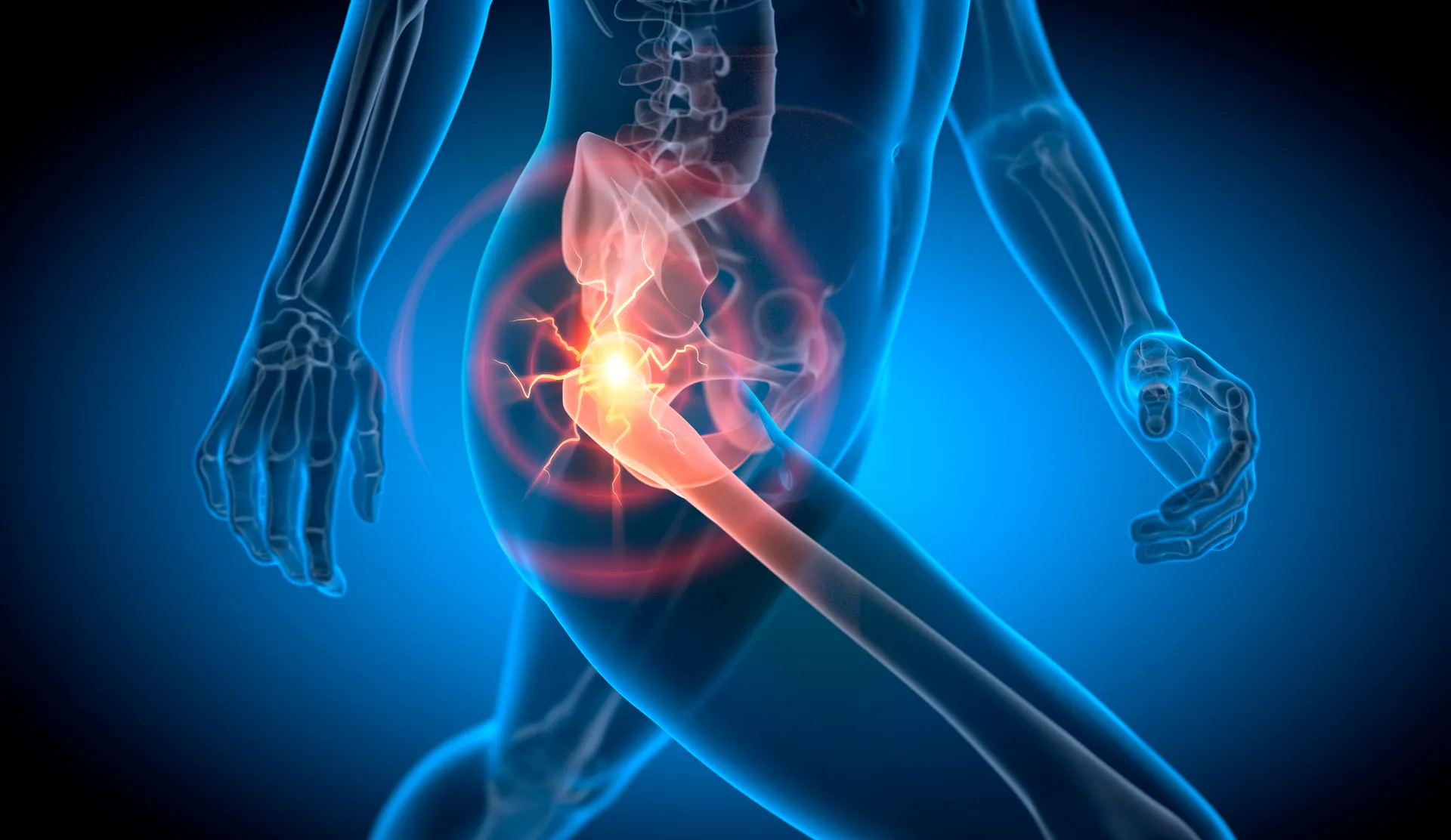
Hip arthritis is the progressive deterioration of the articular cartilage within the hip joint, where the smooth cartilage covering the femoral head and the acetabular socket erodes over time, producing pain, stiffness, and reduced mobility as the protective surface between the ball and socket thins and eventually exposes the underlying bone.
Subchondral sclerosis, the abnormal hardening and thickening of the bone directly beneath the damaged cartilage surface caused by increased mechanical stress transmission through bone that cartilage no longer cushions, is a radiographic hallmark of hip arthritis that Metro Pain Centers identifies on X-ray to confirm disease progression and plan treatment intensity.
The hip joint is the second most commonly affected joint by osteoarthritis after the knee. Approximately 25 percent of adults will develop symptomatic hip osteoarthritis during their lifetime, with prevalence increasing after age 60.
Metro Pain Centers treats primary osteoarthritis, post-traumatic arthritis, inflammatory hip arthritis, and avascular necrosis-related degeneration of the hip. Our physicians stage the disease and match treatment to the degree of cartilage loss because early-stage and advanced hip arthritis require different interventions.
Understanding Your Condition
Our board-certified physicians use advanced diagnostic techniques to accurately identify the source of your pain, ensuring you receive the most effective treatment.
Symptoms of Hip Arthritis
Groin pain that develops gradually with walking and weight-bearing is the most common presentation. The pain worsens over months as cartilage thins. Metro Pain Centers evaluates the onset pattern to distinguish hip arthritis from acute hip injuries.
Stiffness that limits internal rotation of the hip is often the first measurable physical finding. Patients notice difficulty pivoting, crossing legs, or rotating the foot inward. Our pain management physicians measure internal rotation loss to track disease progression.
A grinding or crunching sensation within the joint during movement indicates bone surfaces contacting each other where cartilage has worn away. Metro Pain Centers correlates crepitus findings with imaging to determine the extent of cartilage loss.
Pain that radiates from the groin to the front of the thigh or the knee confuses many patients who believe the problem originates in the knee. Our specialists recognize this referred pain pattern as a hallmark of hip joint pathology.
What Causes Hip Arthritis
Age-related cartilage degeneration is the primary cause of hip osteoarthritis that Metro Pain Centers diagnoses. The articular cartilage loses water content and elasticity over decades, reducing its ability to absorb the repetitive compressive forces of walking and standing.
Femoroacetabular impingement accelerates cartilage breakdown by creating abnormal contact between the femoral head and acetabular rim. Years of this repetitive impingement damage the cartilage and labrum. Metro Pain Centers identifies impingement-related arthritis in patients who developed hip symptoms earlier than expected.
Previous hip fracture or dislocation disrupts the joint surface and initiates post-traumatic arthritis at the injury site. A hip fracture in your fifties can produce significant arthritis in the same joint within ten to fifteen years. Our physicians assess trauma history during every hip evaluation.
Hip dysplasia, where the acetabulum does not fully cover the femoral head, concentrates weight-bearing forces onto a smaller cartilage area. This concentrated load accelerates wear. Metro Pain Centers evaluates acetabular coverage on X-ray to identify dysplasia as a contributing factor.
How Metro Pain Centers Diagnoses Hip Arthritis
Physical examination measures hip range of motion with emphasis on internal rotation loss, tests for pain with the FADIR and log-roll maneuvers, and assesses gait asymmetry. Our board-certified pain specialists use these findings to determine whether the hip joint is the primary pain source.
Weight-bearing AP pelvis and frog-leg lateral X-rays reveal joint space narrowing, osteophyte formation, subchondral sclerosis, and subchondral cyst formation. Metro Pain Centers compares both hips on the same film to detect asymmetric wear patterns.
MRI visualizes early cartilage changes, bone marrow edema, and labral pathology that X-rays miss. Our physicians order hip MRI when the clinical picture suggests early arthritis or when treatment planning requires detailed structural information.
Diagnostic hip joint injections under fluoroscopic guidance confirm the hip as the pain generator. When the injection eliminates groin pain, Metro Pain Centers uses that confirmation to direct ongoing treatment at the verified source and rule out referred pain from the lumbar spine.
Treatment Options for Hip Arthritis at Metro Pain Centers
Intra-articular hip injections with corticosteroid reduce inflammation and pain within the arthritic hip joint. Metro Pain Centers performs these under fluoroscopic guidance because the hip joint sits deep beneath layers of muscle and requires precise needle navigation.
Viscosupplementation with hyaluronic acid restores lubrication and cushioning within the hip joint capsule. Our physicians recommend viscosupplementation for moderate hip arthritis when patients need longer-lasting relief between corticosteroid cycles.
Interventional pain management at Metro Pain Centers includes radiofrequency ablation of the hip articular sensory nerves for patients whose pain returns after injection therapy, providing six to twelve months of relief by interrupting pain signaling from the joint.
Physical therapy strengthens the hip abductors, external rotators, and core muscles to reduce mechanical load on the arthritic joint surfaces. PRP therapy delivers concentrated growth factors into the hip joint to support cartilage preservation and reduce inflammation.
Schedule an appointment to discuss your hip arthritis treatment plan.
Your Hip Arthritis Specialists at Metro Pain Centers

EXPERIENCE
Led by Dr. Rahul Sood
Led by Dr. Rahul Sood, Chairman of Anesthesiology at New Bridge Medical Centers, Metro Pain Centers delivers multilingual care in English, Spanish, Punjabi, and Hindi across all 12 offices.
Our physicians hold board certifications in anesthesiology and pain medicine, with training from Mount Sinai, Rutgers, and Thomas Jefferson University.
Related Conditions Treated by Metro Pain Centers
Hip arthritis frequently coexists with other conditions our physicians treat. Hip pain is the symptom that brings most hip arthritis patients through our doors, and confirming arthritis as the specific cause shapes the treatment plan.
Hip bursitis develops alongside hip arthritis when altered gait mechanics irritate the trochanteric bursa. Hip labral tears precede or accompany hip arthritis in many patients. Arthritis in the opposite hip or the knees is common when systemic degeneration affects multiple joints.
View all conditions we treat at Metro Pain Centers.
Hip Arthritis Treatment at 12 NJ and NY Locations
Does hip arthritis always require hip replacement?
Most patients with hip arthritis can be managed with non-surgical treatments for years. Metro Pain Centers provides injections, nerve ablation, physical therapy, and regenerative options that help many patients avoid or significantly delay surgery.
What stage of hip arthritis do I have?
Metro Pain Centers stages hip arthritis using X-ray findings including joint space narrowing, osteophyte size, and subchondral bone changes. Your physician will explain your stage and what it means for treatment options.
Can exercise make hip arthritis worse?
Low-impact exercise strengthens the muscles that support the hip and reduces load on the joint. High-impact activities can accelerate cartilage wear. Metro Pain Centers guides patients toward the right activity level for their disease stage.
Why does my knee hurt when the problem is in my hip?
The hip joint shares nerve pathways with the front of the thigh and knee through the obturator nerve. Metro Pain Centers uses diagnostic hip injections to confirm when knee-area pain originates from the hip.
Does insurance cover hip arthritis treatment at Metro Pain Centers?
Metro Pain Centers accepts most major insurance plans. Our billing team verifies your coverage and explains costs before any procedures.
Hear From Our Patients
The doctors actually listen to you and take time to explain everything. I finally found relief after years of back pain.
From my first visit, I felt like they genuinely cared about helping me get better. The staff is wonderful and the treatments changed my life.
After seeing multiple doctors with no improvement, Metro Pain Centers finally gave me a treatment plan that works. I can't recommend them enough.
Get Relief from Hip Arthritis Today
The grinding with every step and the stiffness that steals your ability to bend, pivot, and walk without a limp do not have to be your permanent reality. Metro Pain Centers delivers the diagnostic precision to stage the damage and the interventional skill to manage it.