Headaches Treatment in NJ & NY
It starts around 2 p.m. at your desk, a vice-grip squeezing both temples that tightens with every email you open. By the time you leave the office the pressure has spread behind your eyes and into the base of your skull. Metro Pain Centers identifies the structural or neurological origin of your headaches and treats it so an afternoon at work stops becoming an afternoon you endure.

Understanding Headaches at Metro Pain Centers
Headaches are pain signals generated by structures inside or outside the cranium, including the meningeal arteries, the trigeminal nerve branches that innervate the face and scalp, the upper cervical nerve roots at C1 through C3, the temporalis and suboccipital muscles, and the cervical facet joints whose irritation can project pain forward over the skull.
A cervicogenic headache pathway, the route by which pain signals travel from the upper cervical spine through the C2 and C3 nerve roots and the trigeminocervical nucleus to produce pain felt in the forehead, temple, and behind the eye, is a mechanism Metro Pain Centers evaluates in every chronic headache patient. When cervical structures drive the headache, treating the neck resolves the head pain.
Approximately 50 percent of adults worldwide experience at least one headache disorder in a given year, and many of those cases involve more than one headache type occurring simultaneously or in succession, complicating self-diagnosis and delaying effective treatment.
Chronic headaches that recur more than 15 days per month affect roughly 3 percent of the global population. Metro Pain Centers distinguishes primary headaches, those without an underlying structural lesion, from secondary headaches caused by cervical pathology, vascular abnormalities, or medication overuse.
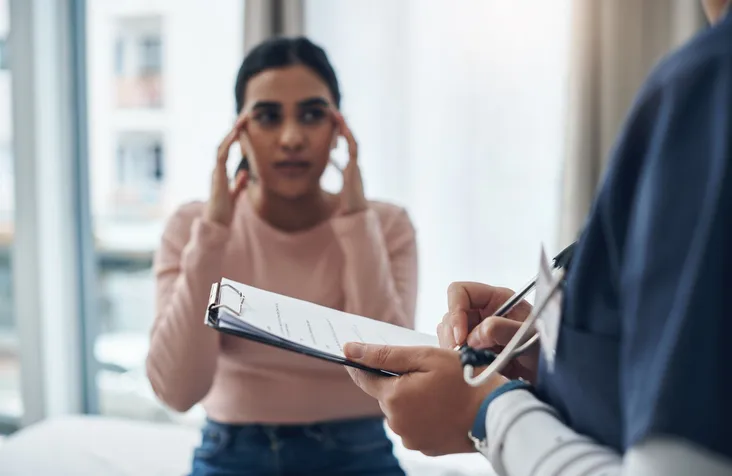
Understanding Your Condition
Our board-certified physicians use advanced diagnostic techniques to accurately identify the source of your pain, ensuring you receive the most effective treatment.
Symptoms of Chronic Headaches
Bilateral pressure that wraps around the forehead like a band is the hallmark of tension-type headache. Metro Pain Centers evaluates whether myofascial trigger points in the trapezius or suboccipital muscles are feeding this pattern.
One-sided throbbing that worsens with physical activity and arrives with nausea or light sensitivity suggests a migraine mechanism. Our physicians distinguish migraine-driven headaches from cervicogenic headaches that mimic the same unilateral distribution.
Pain originating at the base of the skull and radiating over the top of the head to the forehead indicates upper cervical involvement. Metro Pain Centers uses diagnostic occipital nerve blocks and C2-C3 medial branch blocks to confirm this pathway.
Headaches triggered by specific neck movements, sustained postures, or pressure applied to the upper cervical spine point toward a structural cervical cause. Our pain management specialists test these mechanical triggers during the physical examination.
What Causes Headaches
Upper cervical facet joint degeneration at C2-C3 is the most common structural cause of cervicogenic headaches that Metro Pain Centers identifies. The C2-C3 facet joint shares innervation with the trigeminal system through the trigeminocervical nucleus, allowing neck pathology to produce forehead and temple pain.
Myofascial trigger points in the upper trapezius, sternocleidomastoid, and suboccipital muscles refer pain into the head in predictable patterns. Metro Pain Centers maps these referral patterns to determine whether muscle dysfunction is the primary generator or a secondary contributor.
Forward head posture increases the mechanical load on the cervical spine by approximately 10 pounds for every inch the head shifts anterior to the shoulders. This overload strains muscles and compresses facet joints, producing a headache cycle that no amount of over-the-counter medication can interrupt.
Medication overuse headache develops when analgesics are taken more than 10 to 15 days per month. Metro Pain Centers identifies this cycle early because the treatment requires supervised withdrawal alongside preventive intervention rather than more medication.
How Metro Pain Centers Diagnoses Headaches
A detailed headache history establishes frequency, duration, location, quality, associated symptoms, and triggers. Our board-certified pain specialists use this intake to classify the headache type and identify red flags that warrant urgent imaging.
Physical examination includes cervical range of motion testing, palpation of the suboccipital and paracervical muscles, Spurling's test for radiculopathy, and manual pressure over the C2-C3 facet joints. Metro Pain Centers uses these maneuvers to detect a cervicogenic origin before ordering advanced studies.
Diagnostic nerve blocks serve as both assessment and preliminary treatment. An occipital nerve block that eliminates the headache confirms greater occipital nerve involvement. A C2-C3 medial branch block that resolves forehead pain confirms cervicogenic headache and directs Metro Pain Centers toward radiofrequency ablation.
MRI of the cervical spine reveals disc degeneration, facet hypertrophy, and nerve root compression that may be generating the headache. Metro Pain Centers orders imaging when clinical examination suggests a structural cause or when neurological signs accompany the pain.
Treatment Options for Headaches at Metro Pain Centers
Occipital nerve blocks deliver local anesthetic and anti-inflammatory medication to the greater and lesser occipital nerves at the base of the skull. Metro Pain Centers uses these blocks for headaches originating from the upper cervical region and the suboccipital musculature.
Cervical medial branch radiofrequency ablation heats the nerves transmitting pain from the C2-C3 facet joints, providing six to twelve months of relief per treatment cycle. Metro Pain Centers performs ablation only after two confirmatory diagnostic blocks verify the facet joint as the pain source.
Interventional pain management at Metro Pain Centers includes trigger point injections for myofascial headaches and cervical epidural steroid injections when disc pathology contributes to the headache pattern.
Physical therapy targets postural correction, cervical stabilization, and suboccipital muscle release to reduce the mechanical drivers behind recurring headaches. Botulinum toxin injections offer preventive relief for patients with chronic migraine-spectrum headaches exceeding 15 episodes per month.
Schedule an appointment to discuss your headache treatment plan.
Your Headache Specialists at Metro Pain Centers

EXPERIENCE
Led by Dr. Rahul Sood
Led by Dr. Rahul Sood, Chairman of Anesthesiology at New Bridge Medical Centers, Metro Pain Centers delivers multilingual care in English, Spanish, Punjabi, and Hindi across all 12 offices.
Our physicians hold board certifications in anesthesiology and pain medicine, with training from Mount Sinai, Rutgers, and Thomas Jefferson University.
Related Conditions Treated by Metro Pain Centers
Headache disorders frequently overlap with other conditions our physicians manage. Migraines involve neurovascular mechanisms that can coexist with cervicogenic headaches, requiring differentiation through diagnostic blocks.
Tension headaches share myofascial trigger point involvement with cervicogenic headaches. Neck pain is both a cause and a consequence of chronic headache patterns. Neck arthritis at the C2-C3 level directly generates cervicogenic headaches.
View all conditions we treat at Metro Pain Centers.
Headache Treatment at 12 NJ and NY Locations
When should I see a specialist for headaches?
Headaches occurring more than twice per week, increasing in severity, or failing to respond to over-the-counter medication warrant specialist evaluation. Metro Pain Centers recommends early assessment to prevent episodic headaches from becoming chronic.
Can neck problems cause headaches?
Cervicogenic headaches originate from the C2-C3 facet joints and upper cervical nerve roots. Metro Pain Centers diagnoses these with diagnostic nerve blocks and treats them with radiofrequency ablation and physical therapy.
What is the difference between a headache and a migraine?
Migraines involve neurovascular changes that produce throbbing pain, nausea, and sensory sensitivity. General headaches may involve muscular, cervical, or other mechanisms. Metro Pain Centers determines the specific type driving your pain.
Are headache injections painful?
Diagnostic and therapeutic nerve blocks use fine-gauge needles and local anesthetic. Most patients at Metro Pain Centers report brief pressure during injection followed by rapid pain relief.
Does insurance cover headache treatment at Metro Pain Centers?
Metro Pain Centers accepts most major insurance plans. Our billing team verifies your coverage and explains costs before any procedures.
Hear From Our Patients
The doctors actually listen to you and take time to explain everything. I finally found relief after years of back pain.
From my first visit, I felt like they genuinely cared about helping me get better. The staff is wonderful and the treatments changed my life.
After seeing multiple doctors with no improvement, Metro Pain Centers finally gave me a treatment plan that works. I can't recommend them enough.
Get Relief from Chronic Headaches Today
The afternoon vice-grip that steals your concentration and the dull ache that follows you home do not have to define your workday. Metro Pain Centers delivers the diagnostic precision to identify the headache generator and the interventional skill to quiet it.